Fixing the Hidden Bottleneck in Complex P&C Claims
Mrutunjay Kinagi, Senior Software Engineer, DocLens.ai
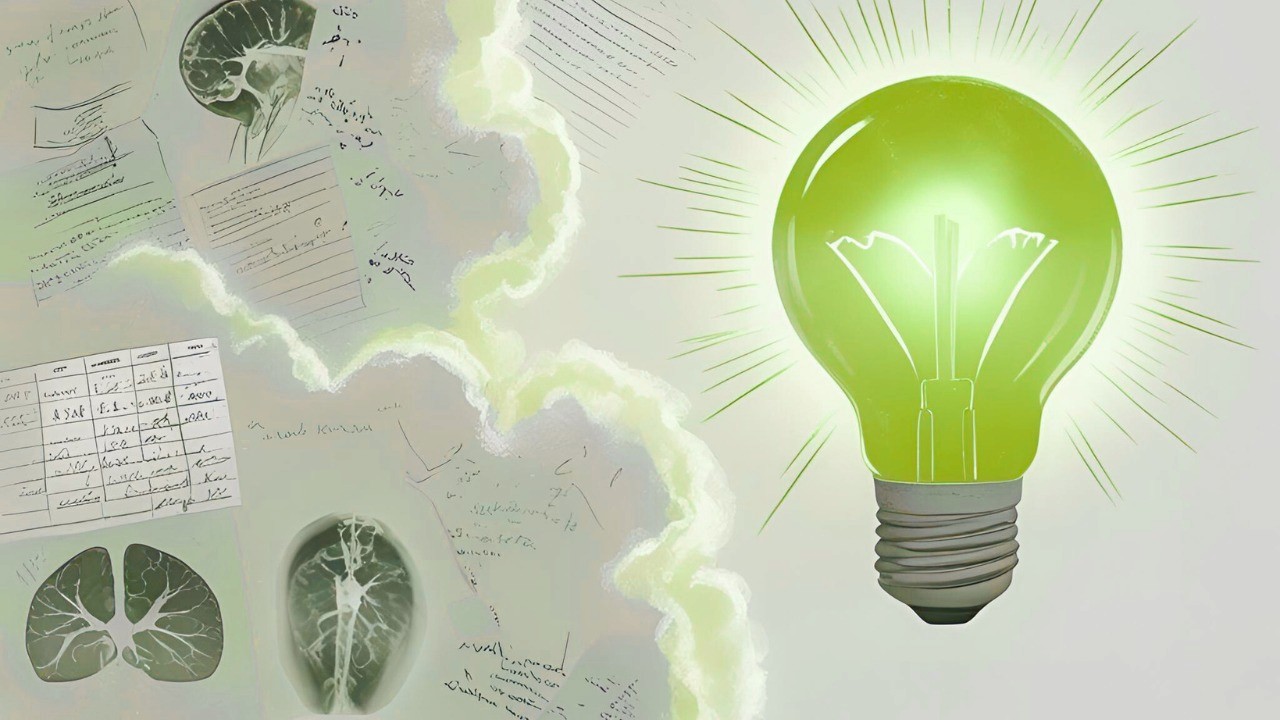
Imagine a detective trying to solve a case with hundreds of clues scattered across dozens of rooms. Every door leads to new information: some useful, some irrelevant, some just noise. Now imagine doing that every day, for every single case. And now imagine you dealing with thousands of clues and thousands of pages across hundreds of documents which have come to your attention over the past several months.
This is what Bodily Injury Liability Claim adjusters face in Property and Casualty (P&C) Insurance.
Some claims are simple. Others are sprawling and messy spanning multiple coverages, loaded with accident reports, medical records, policy details, legal notices, and even handwritten notes. Adjusters are expected to go through every piece of this puzzle manually, draw insights, find inconsistencies, and move the claim forward. It’s time-intensive, error-prone, and often overwhelming.
The result? Delays, higher risk of losses, compliance gaps, and burnt-out teams.
Meet ClaimLens™
ClaimLens™ by DocLens.ai is like a co-pilot for your adjusters trained to read, reason, and respond intelligently. It's built to handle complexity without the clutter.
At the heart of it is an Agentic AI system which integrates with both unstructured documents that are part of the claim as well as APIs that retrieve information from Systems of Records such as Guidewire. A lightweight orchestration layer called the Model Context Protocol (MCP) enables easy orchestration between these (and potentially several more) relevant but disparate information sources. Think of the AI system as the brain that helps ClaimLens™ understand what to do and how to do it — almost like giving your claims assistant the power to interpret instructions and run errands across multiple systems.
So when an adjuster types something like:
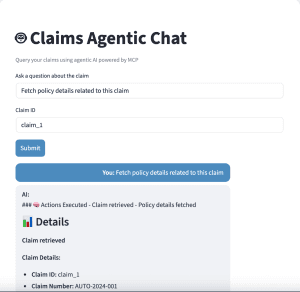
“Fetch policy details related to this claim”
Here’s what ClaimLens™ does behind the scenes:
Understands the request like a human would
Finds and processes structured data from systems like Guidewire ClaimCenter
Reads through unstructured documents
Identifies what “this claim” means
Finds the corresponding policy and its associated latest endorsements and renewal
Returns a concise summary with insights and suggested next steps
What used to take hours of scrolling, clicking, and cross-referencing now takes minutes and comes back in natural language.
Experience It Yourself: Real Chat. Real Time.
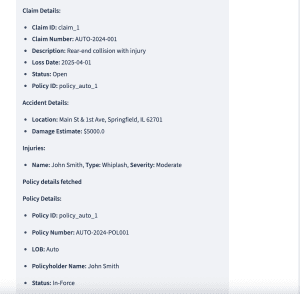
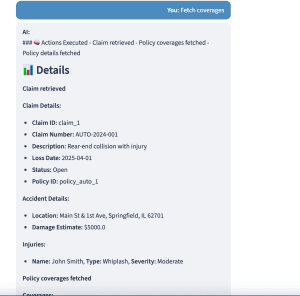
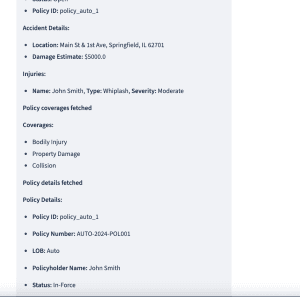
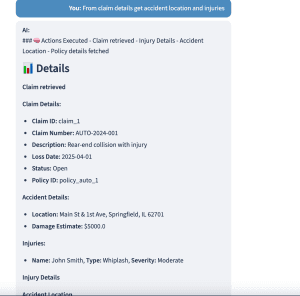
To show what this might look like, we built a mock setup:
Ask: “What documents are associated with claim_1? What are the reported injuries?” Get: A clean list of documents, injury summaries, and recommended follow-ups
This simple chat interface runs on a mock Guidewire setup using:
Flask-based APIs
A lightweight MCP brain
A Streamlined interface for smooth interaction
  |
  |
 |
How It Can Come Together Inside Guidewire ClaimCenter
Think of ClaimLens™ as a quiet observer that springs into action at the right moment. Here’s how the workflow unfolds:
Flag the claim Turn on a simple toggle: sendToClaimLens = true This tells the system, “Keep an eye on this one.”
Trigger events, not delays ClaimLens™ listens for actions like Claim Created or Claim Updated. These events automatically trigger ClaimLens™ via secure AWS connections — no polling or waiting.
Bring in the data ClaimLens™ pulls both structured fields and unstructured docs in real time. Then it parses, indexes, and stores them in AWS for quick access and deep analysis.
Reference : https://docs.guidewire.com/cloud/cc/202503/cloudapibf/cloudAPI/topics/landing_Cloud-API-consumer.html
Let the AI do the heavy lifting Once the data is in, ClaimLens™ gets to work:
Summarizes the claim and medical narratives
Flags missing coverage or high-risk signals
Suggests what to do next
Enables adjusters to ask natural language questions and receive meaningful answers
All answers are explainable with citations pointing back to the relevant document from where the information was extracted through AI techniques.
ClaimLens™ Doesn’t Just Answer. It can Write Back!
ClaimLens™ plugs directly into Guidewire in two ways:
Embedded chat interface: Adjusters can chat with ClaimLens™ right inside their existing Guidewire ClaimCenter wizard, getting instant help without switching tabs.
Full API access: Every insight and recommendation is also available through secure APIs, enabling deeper automation and integrations.
ClaimLens™ isn’t just another dashboard. It’s part of the workflow.
Engineered for Trust and Compliance
The platform is built to meet enterprise-grade security standards from the ground up. It uses mutual TLS and OAuth2.0 for secure communication, integrates seamlessly with federated single sign-on via Guidewire Hub, and ensures end-to-end encryption through AWS Key Management Service. Compliance is maintained with guardrails powered by AWS Control Tower, WAF, and GuardDuty. ClaimLens™ is also certified for SOC 2 Type I and II and HIPAA, underscoring its commitment to data protection and regulatory compliance. For full details, visit the DocLens.ai Trust Center.
Why It Matters
At its core, ClaimLens™ is not a tool. It’s an intelligent teammate.
It helps Claim adjusters do what humans do best, make judgment calls and drive outcomes, while the machine handles the reading, summarizing, and suggesting.
Resolve faster. Protect better. Lead smarter. Let your teams focus on what matters most: outcomes, not overhead.
Learn more at DocLens.ai Integration support: support@doclens.ai
Disclaimer: This is a conceptual demonstration, not a production deployment. It reflects the art of the possible when combining conversational AI with claims workflow systems like Guidewire ClaimCenter.


Follow us: