We ran the numbers on ClaimLens vs. Claude. The gap surprised even us.
Ramdoot Pydipaty, Principal Engineer, Doclens.ai

The question we stopped debating and started testing
Every insurance team evaluating AI right now faces the same fork in the road: adopt a powerful generalist model like Claude, or invest in something built specifically for the job. It's a real question, and frontier models are genuinely impressive. So we decided to stop debating it and test it.
We benchmarked ClaimLens, our purpose-built claims risk assessment engine, head-to-head against Claude's latest models, Sonnet 4.6 and Opus 4.8, on the same claims, the same questions, the same conditions. What came back wasn't a marginal edge. It was a fundamental performance gap.
ClaimLens hit 92.14% precision and 89.99% recall. Claude landed around 50% precision and low-to-mid 60s on recall, for both models. That's a 40+ percentage point gap in precision alone.

In claims assessment, those aren't abstract numbers. Precision is how often a flagged claim is actually worth flagging: miss it, and you're triggering unnecessary rejections and manual reviews. Recall is whether you catch the high-risk claims that genuinely need scrutiny: miss it, and risk slips through. A model that's wrong on one or the other isn't a rounding error. It's rework, it's customer friction, it's exposure.
Where does the gap actually come from?
We split the test questions into two buckets. Objective questions have a single correct answer: the claimant's name, the location of the accident, facts you either extract right or don't. Subjective questions require reasoning: spotting potential disputes, synthesizing what happened across multiple documents, the kind of judgment an experienced adjuster brings to a file.
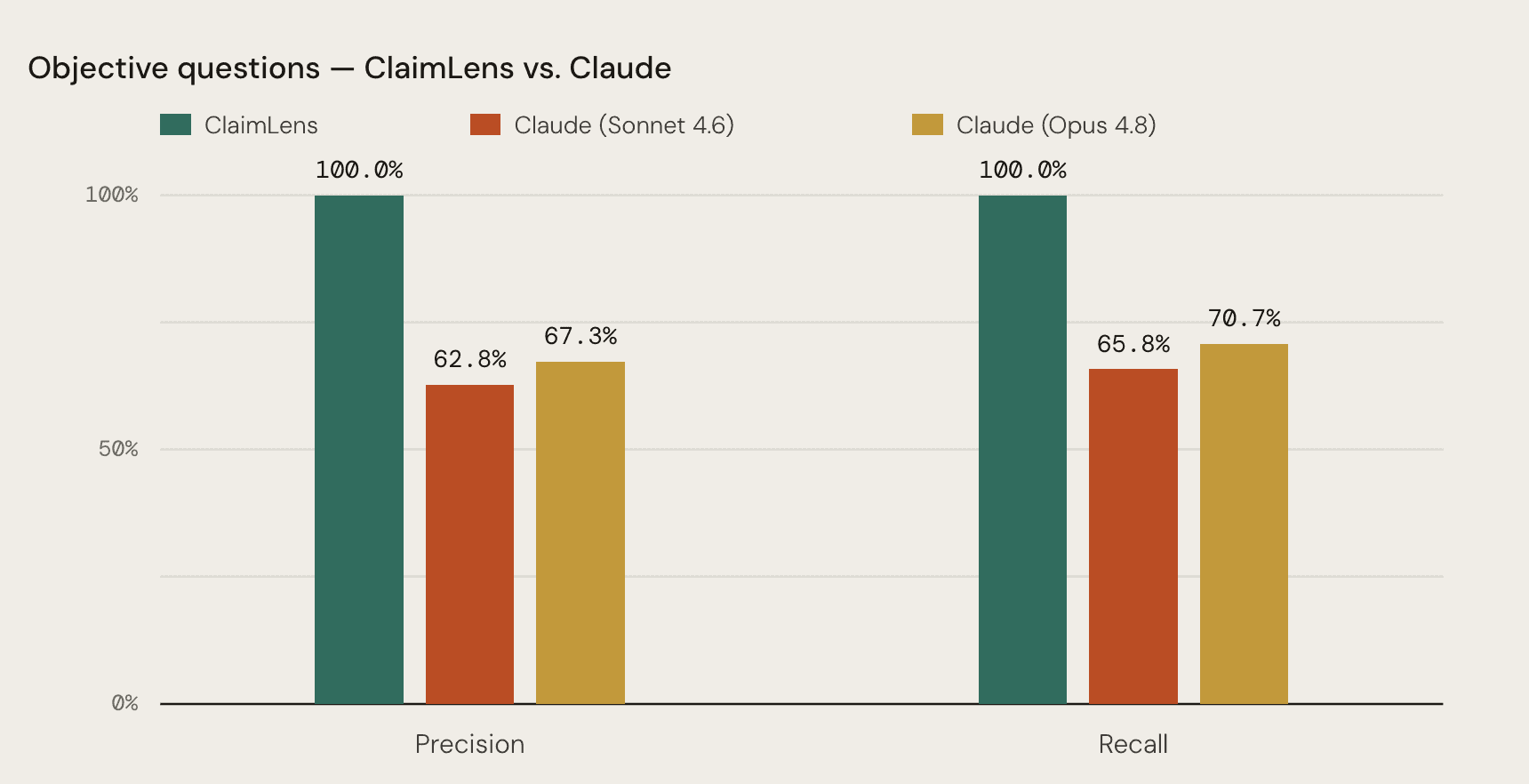
On the objective questions, the ones that should be easiest, ClaimLens scored 100% precision and 100% recall. Claude scored in the mid-60s on both metrics. Even on straightforward extraction, a generalist model getting one in three answers wrong is a real problem when that answer feeds into a liability decision.
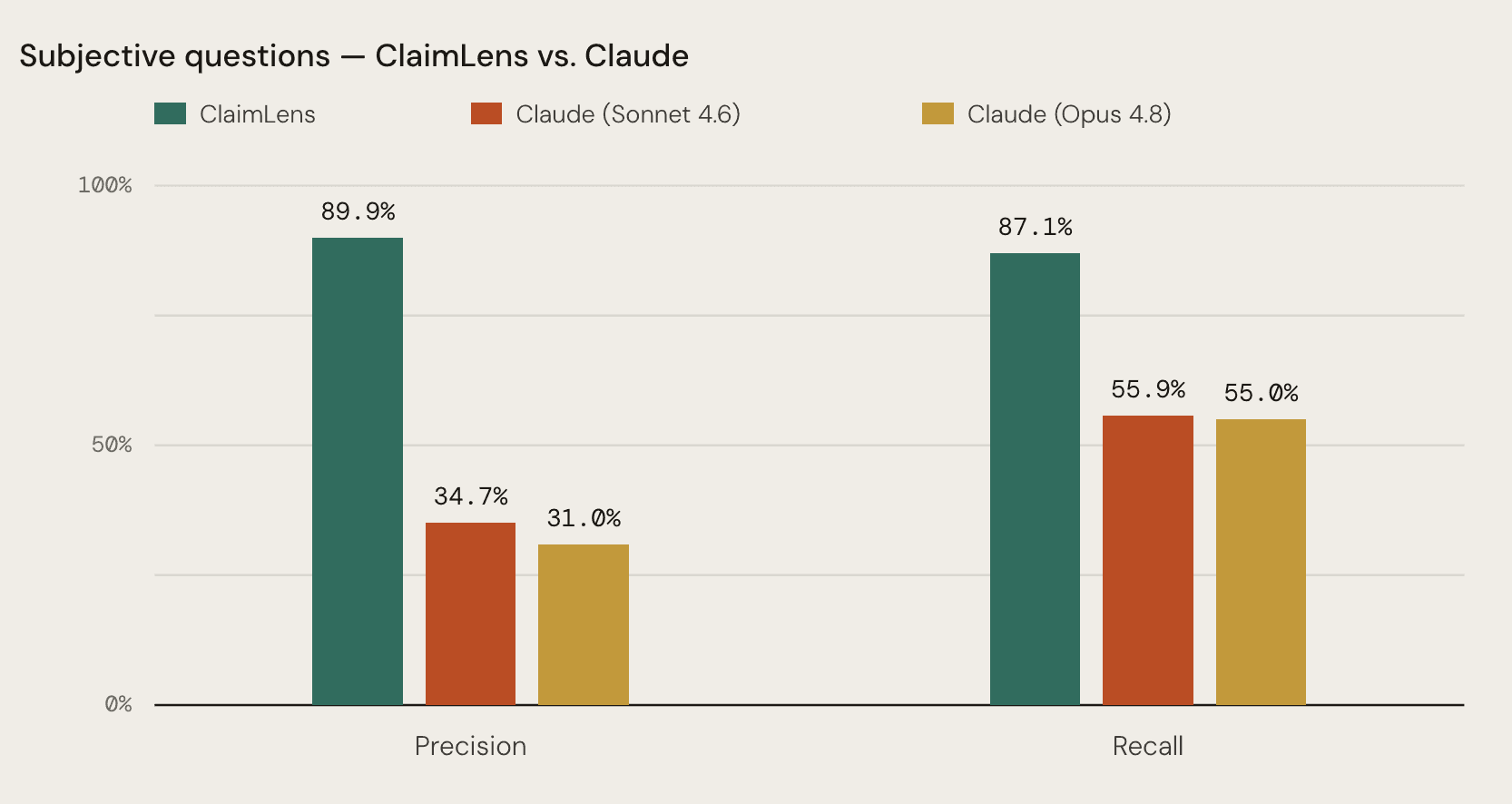
Then we looked at the harder questions, the ones requiring actual claims judgment. This is where the story gets interesting: the gap doesn't shrink, it widens. ClaimLens held steady at 89.90% precision and 87.10% recall. Claude dropped further, into the 30s on precision and mid-50s on recall.
Frontier models are trained on the whole internet: broad, general, remarkable at a thousand things. Claims evaluation isn't a thousand things — it's one thing, done with deep context.
That's the tell. Risk frameworks, dispute patterns, what "normal" looks like in a claim file versus what should raise a flag — that's not a training-data problem Claude can search its way out of. It's a specialization problem.
Why purpose-built wins here
Think of it like a general-purpose truck versus a medical ambulance. The truck can do almost anything reasonably well. But when the job is specific and the stakes are high, you don't want "reasonably well," you want the vehicle engineered for exactly that job. ClaimLens was built the same way: domain-specific risk frameworks, validation rules calibrated for insurance claims, and workflows designed around how adjusters actually work, not adapted from a general-purpose foundation after the fact.
Domain-Specific Knowledge — ClaimLens includes risk frameworks, assessment criteria, and validation rules specifically calibrated for insurance claims.
Contextual Understanding — ClaimLens comprehends the nuances of claim patterns and risk factors that generalist models miss.
Operational Optimization — Every design decision prioritizes accuracy, interpretability, customer feedback, and integration with existing claims workflows.
What this means if you're processing claims at scale
Run the math on a real book of business. If you're processing thousands of claims a month, a 40-point precision gap doesn't stay theoretical. It becomes thousands of misjudged claims: manual review costs stacking up, customers frustrated by claims handled wrong, regulatory exposure, and, the one that should worry every risk leader, fraud that slips through because the model's confidence didn't match its accuracy. A recall gap means you're missing risk signals and diluting adjuster trust in the value of the tool.
The takeaway
This isn't an argument that generalist models like Claude aren't good. They clearly are, and they're advancing fast. It's a reminder that "good in general" and "good for your specific, high-stakes workflow" are two different bars. For claims risk assessment, the data is unambiguous: ClaimLens's 92.14% precision and 89.99% recall aren't just better benchmark numbers, they're the difference between an AI tool you can build a claims operation on and one you can't.
As more insurers evaluate AI for claims, the question worth asking isn't "which model is most powerful." It's "which model was actually built for this."
"Good in general" and "good for your specific, high-stakes workflow" are two different bars.
See how ClaimLens performs on your claims. Talk to us about running the benchmark on your own book of business.
Annexure — Benchmark Questions
The evaluation set spanned four claim-document categories, split between objective, fact-extraction questions and subjective, judgment-based questions.
Question Category | Question | Question Type |
|---|---|---|
Claim Summary | What is the name of the claimant? | Objective |
Claim Summary | What is the claimant's age at the time of the incident? | Objective |
Claim Summary | Can you describe the incident that took place? | Subjective |
Claim Summary | What are the financial implications for the claimant as a result of this incident? | Subjective |
Medical Summary | What are the injuries or medical conditions the claimant has suffered due to the incident? | Subjective |
Medical Summary | What co-morbidities does the claimant have? | Objective |
Risk Report | What are the top risk signals in the document? | Subjective |
Risk Report | If the case is in litigation, what is the venue and who are the attorneys involved? | Objective |
Demand Summary | What do the medical bills present in the document add up to? | Objective |


Follow us: